

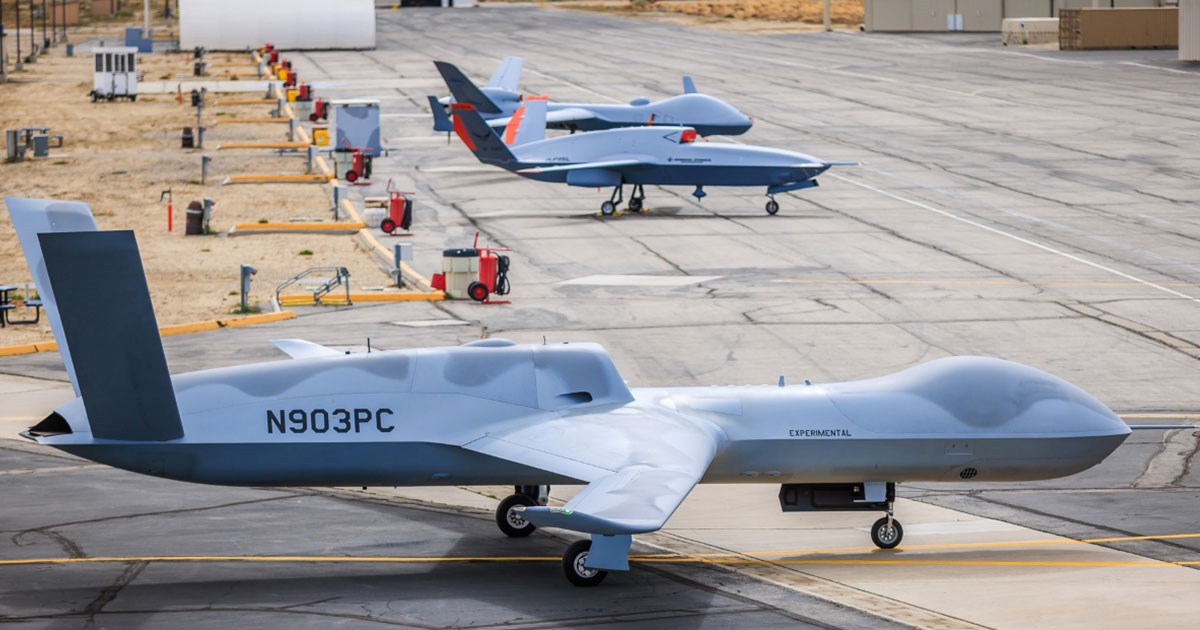
The demonstration centered on the MQ-20 Avenger®, which acted as a surrogate for a Collaborative Combat Aircraft (CCA). Operating in a challenging Emission Control (EMCON) environment to avoid detection, the jet was autonomously tasked and controlled using the Tactical Autonomy Core Ecosystem (TacACE). This system merged space-based and tactical sensing data, providing the MQ-20 with a comprehensive, real-time picture of the battlespace for enhanced onboard decision-making.
A key element was the use of distributed-edge Command and Control (C2) nodes powered by GA-Intelligence’s Optix.C2 and Omniview software. This allowed for low-latency control of the aircraft while keeping it networked into the broader operational plan, enabling real-time coordination across multiple domains through a single, cloud-deployable interface.
During the live-flight exercise, the MQ-20 autonomously patrolled a designated zone. An operator then directed a team of four CCA surrogates—one live and three virtual—to investigate multiple targets. After the system identified these targets as hostile, the operator authorized a beyond-line-of-sight engagement. The autonomous systems then maneuvered into position, simulated missile launches, conducted battle damage assessments, and returned to their patrol station without further human input.
Company officials hailed the event as a major leap forward. “This is the future of warfare — scalable, autonomous systems that empower the warfighter to dominate at range,” said Michael Atwood, VP of Advanced Programs at GA-ASI. The demonstration underscores the rapid advancement of human-machine teaming, delivering a capable and intuitive system that minimizes operator workload while closing the kill chain with unprecedented speed.
